Organization Architecture: 17 Steps to Profitable Scale from Scratch (2026)
A complete, practical blueprint from idea to execution, leadership, systems, and scale.

The complete Organization Architecture framework for 2026.
1. Introduction: Why “Organization Architecture” Matters More Than Just Hiring
Most founders think building a company means hiring a team, assigning roles, and giving titles. However, without a proper Organization Architecture, this approach leads to chaos.
In reality, hiring is only a small part of the truth. True Organization Architecture is about designing a living system that produces outcomes.
An organization is not a building.
It is not a set of departments.
It is not a CEO with a few managers under them.
An organization is a living system designed to repeatedly produce outcomes—revenue, impact, service delivery, product quality, learning, innovation, customer satisfaction, and growth.
That is why the process of creating a company from scratch is best described as Organization Architecture, not just “staffing.”
A Building Needs:
- A purpose (what it is built for)
- A design (layout, flow, safety, efficiency)
- A strong foundation
- High-quality engineering
- Maintenance systems
A Company Needs:
- A clear mission
- A clear business model
- Defined roles & decision rights
- Operational systems & metrics
- Funding & Governance
The Biggest Mistake Early Founders Make
They build the org chart first. They start with:
But they forget to design the Organization Architecture first: What must happen daily? What does success look like? What systems prevent chaos?
So they build a company full of people… but without a machine that produces consistent results.
2. Start With the “Idea”: The Real Origin of Any Organization
Every organization begins with an idea. But an idea is not enough. A usable idea must be shaped into a problem-solving mission.
2.1 Idea vs Opportunity (Know the difference)
- × “Let’s start a school.”
- × “Let’s launch an EdTech company.”
- × “Let’s create a consulting firm.”
- × “Let’s open a coaching institute.”
Driven by Emotion
- ✓ “Schools are struggling to implement NEP operationally.”
- ✓ “Parents want premium outcomes at affordable fees.”
- ✓ “Institutions need better teacher performance systems.”
- ✓ “Students need skill-based learning, not only theory.”
Driven by Market Gaps
2.2 Convert your idea into a problem statement
Use this architectural formula:
“We help {target customer} to solve {pain/problem} using {solution approach} so that they achieve {desired outcome}.”
“We help private K-12 schools to improve learning outcomes and admissions using structured academic systems and sales processes so they grow revenue and student satisfaction.”
2.3 Validate demand before building structure
🛑 STOP: Do Not Build Yet
Office • Departments • Expensive Hiring
✅ START: Validate First
Is the problem real? • Do they pay? • Is there urgency? • Can you deliver better?
2.4 The 3 Critical Questions
Is it Urgent?
If people can ignore the problem, they won’t pay to solve it.
Is it Reachable?
If you can’t reach the decision-makers, you can’t sell to them.
Can it Scale?
If every delivery depends on the founder personally, growth is impossible.
3. Define the “Purpose Layer”: Mission, Vision, Values
The Identity of the Organization
What you do, For Whom, and Why.
“To help institutions build high-performance academic and business systems that increase outcomes, admissions, and operational efficiency.”
Ambitious, Measurable, Inspiring, Directional.
“To become India’s most trusted school transformation partner for 10,000+ institutions by 2035.”
3.3 Values: The Operating Behavior Code
Values must be actionable, not decorative. Values become the decision-making system when pressure rises.
3.4 Why Purpose Matters
Without the Purpose Layer, architecture collapses into chaos:
- ⚠️ Hiring becomes Random
- ⚠️ Culture becomes Accidental
- ⚠️ Strategy becomes Reactive
- ⚠️ Teams become Political
- ⚠️ Execution becomes Chaotic
4. Strategy Layer: Where to Play, How to Win, and What to Prioritize
Strategy is not motivation.
Strategy is not fancy slides.
Strategy is a clear decision model that says: what we will do, what we won’t do, where we will focus resources, and how we will win.
4.1 The Strategy Triangle
Where to Play
Market, Customer Segment, Geography, Pricing, Category.
How to Win
Differentiation, Cost Advantage, Quality Advantage, Speed, Trust.
Capabilities
Sales Engine, Operations Excellence, Technology, Delivery Systems.
4.2 Strategy Begins with Choosing a Segment
Your Organization Architecture must change based on the segment you choose.
4.3 Define Strategic Goals (12–36 Months)
Strategy is not broad. Strategy is measurable.
4.4 Strategic Priorities: Reduce Chaos
Without priorities, founders create fire daily. Pick 3–5 priorities to protect the organization from distraction.
- Build lead generation engine
- Close high-ticket customers
- Systemize delivery (SOPs)
- Build core leadership team
- Ensure financial discipline
5. The Business Model Layer: How Money Actually Enters
[Image of business model canvas]Many organizations collapse because they confuse activity with revenue. They think:
None of this matters if revenue is unpredictable or margins are weak.
5.1 Define Your Revenue Streams
How does cash actually flow?
5.2 Pricing is Architecture, Not Math
Pricing decides who comes, how you look, and what talent you can afford.
LOW PRICE ARCHITECTURE
- Attracts High Volume
- Creates High Ops Pressure
- Attracts Cost Sensitivity
HIGH PRICE ARCHITECTURE
- Attracts Lower Volume
- Creates High Expectations
- Attracts Quality Focus
5.3 Your Margin Decides Your Organization Design
6. Operating Model: The Real Architecture
This is the most important section of your Organization Architecture. Because the operating model is the machine.
⚠️ If your operating model is weak, your organization will always depend on:
6.1 What is an Operating Model?
It is not just a fancy term. It is the combination of specific gears:
6.2 Design Workstreams Before Hierarchy
Typical Core Workstreams:
- Lead Generation
- Sales Conversion
- Delivery / Operations
- Finance & Compliance
- HR & Talent
- Customer Success & Retention
- Quality & Improvement
- Tech / Automation
“Once workstreams are clear, roles become clear.”
6.3 Define “Inputs → Outputs” for Each Function
If you cannot define outputs, you cannot build accountability.
- Leads
- Customer Meetings
- Proposals
- Closures
- Revenue
- Collections Forecast
- Signed Project Scope
- Project Timeline
- Team Resources
- Successful Implementation
- Customer Outcomes
- Renewals
7. Organization Structure: Functions, Teams, and Reporting Lines
Once the operating model is clear, structure becomes logical. Structure follows strategy.
7.1 The Three Most Common Structures
Functional
Best for: Early Stage
Product / BU
Best for: Scale / Multi-product
Matrix
Best for: Enterprises (Complex)
7.2 A Smart Org Chart is Not Tall, It is Clear
❌ THE OLD WAY
- Title-Driven
- Heavy & Expensive
- Slow Decisions
✅ THE SMART WAY
- Outcome-Driven
- Flat & Agile
- Fast Execution
7.3 Build Roles in “Pods”
8. Leadership Architecture: Founder, C-Suite, VP, Directors, Managers
“Build leadership based on complexity, not ego.”
8.1 The Correct Order of Leadership Building
THE FOUNDATION (Start)
- Founder/CEO: Vision + Sales + Culture
THE OPERATORS (Validation)
- Ops Leader: Execution + Process
- Revenue Leader: Sales Engine
- Delivery Leader: Customer Success
THE SPECIALISTS (Growth)
- Finance & Compliance Leader
- HR Leader
- Marketing Growth Leader
THE SCALE LAYER (Expansion)
- Managers & Senior Managers
- Directors
- VP / AVP / CXOs (Only Here)
8.3 When Do You Need VP/AVP Roles?
You need these layers ONLY when:
- Headcount grows beyond 50–100
- Managers are managing managers
- You need regional leadership
8.4 The Real Job of the C-Suite
9. Staffing and Hiring: The Right People, In the Right Order
9.1 The Hiring Philosophy
9.2 Hire for “Ownership”
9.3 The Cost of Wrong Hiring
9.4 Staffing Ratio Thinking
10. Culture Architecture: How Behavior Is Designed
10.1 What Culture Really Is
REWARDED
Promotions, Bonuses
PUNISHED
Firing, Warnings
TOLERATED
The “Silent Killer”
10.2 High Performance Behaviors
- ✓ Weekly reporting is mandatory.
- ✓ Targets are respected like law.
- ✓ Meetings have Agenda + Minutes.
- ✓ No blame, only Root Cause Analysis.
11. Systems and SOPs: Repeatable Delivery
11.1 Types of Systems Needed
11.3 The Weekly Operating Rhythm
12. Governance: Board, Advisors, Controls
12.1 Advisory Board vs Formal Board
Informal Advisors
Mentors, Experts
Formal Board
Legal Directors
13. Funding and Financial Architecture
13.2 The Founder’s Financial Dashboard
14. Scaling: From Small Team to Mature Enterprise
14.1 Signs You Are Ready
14.2 What Breaks During Scaling
Communication
Diluted info.
Culture
New hires dilute values.
Speed
Slower decisions.
Accountability
“Not my job” syndrome.
15. Common Mistakes
17. Conclusion: Building a Machine, Not a Crowd
🚫 NOT ABOUT
- Big Titles
- Heavy Teams
- Fancy Hierarchy
- Motivation Speeches
⚙️ ABOUT BUILDING A MACHINE:
- Repeatedly Win Customers
- Deliver Quality Outcomes
- Create Profits
- Scale Sustainably
A perfect organization is not one that looks big.
A perfect organization is one that performs big.
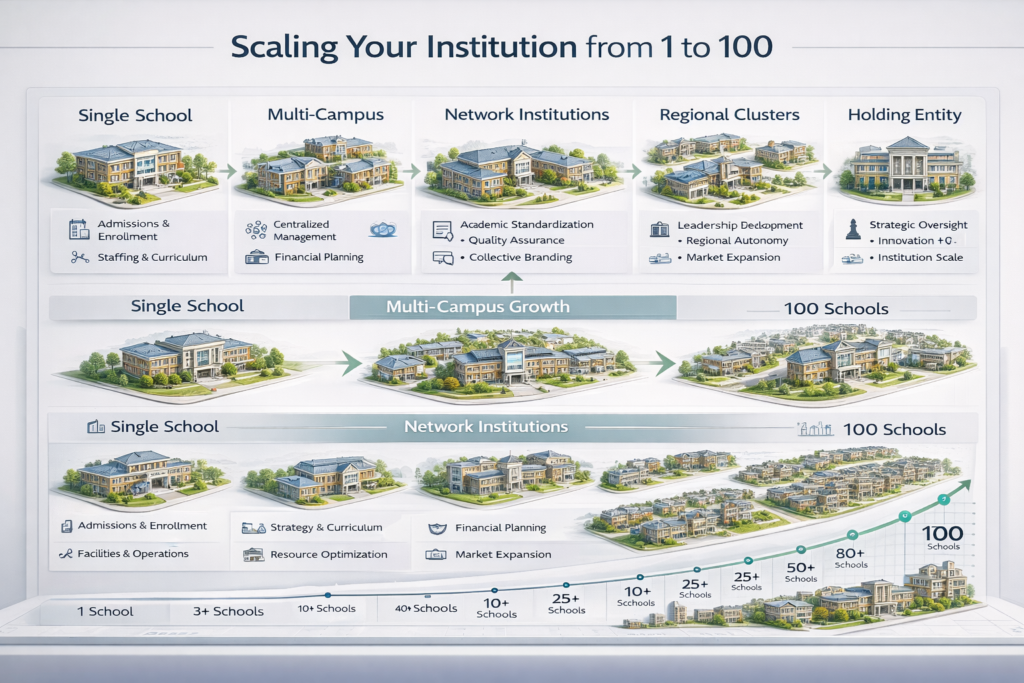
Pingback: Scaling Your Institution From 1 To 100: The Hidden Strategy Of Successful Institutions | Dr Ritesh Prasad
Pingback: NEP 2030: The Proven NEP 2020 Implementation Framework For Schools
Pingback: The Business Of Education: A Proven Framework For Institutional Profitability (2026)
Pingback: Digital Transformation For Schools: The Step-by-Step Implementation Blueprint (2026–2030 Ready)
Pingback: Strategic K-12 Salary Increment & Promotion Calculator Mastery
Pingback: Institutional Auditing Mastery: 50 Powerful Steps To Revitalize Your School
Pingback: The Best & Shocking Roadmap For AI Transformation For Schools.
Pingback: Designing K-12 Ventures From Scratch: 50-Point School Blueprint
Pingback: Entrance Exam Preparation: 100-Point Ultimate Guide For Growth