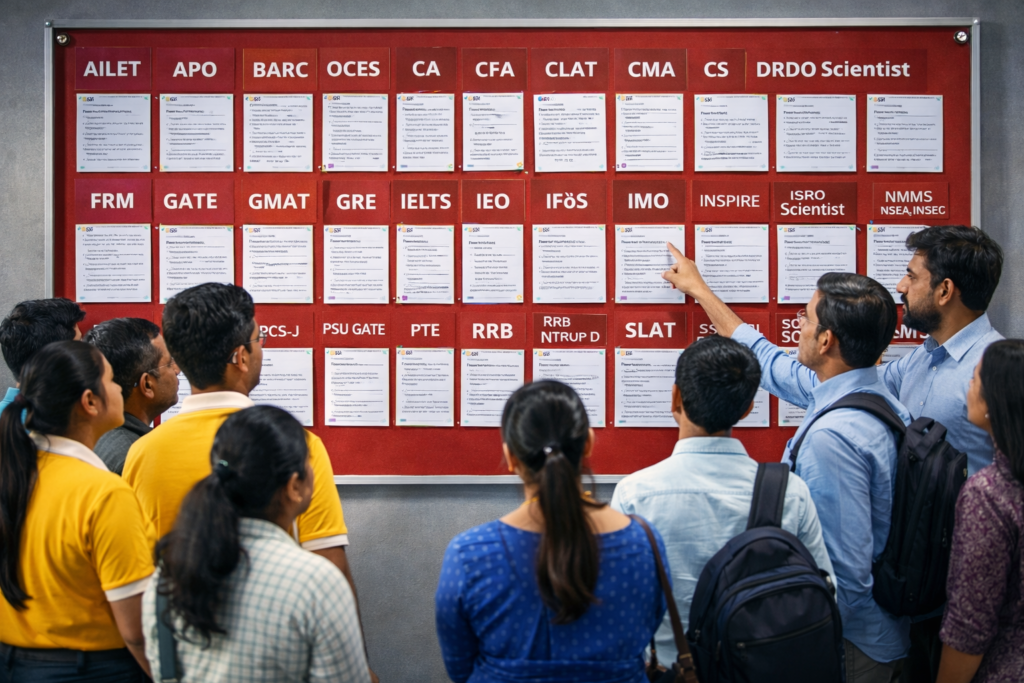


A Comprehensive Test Preparation Ecosystem
A 100-Point Architecture Covering NEET, JEE, UPSC, SSC, CA &
All Competitive Examinations

A serious Entrance Exam Preparation
ecosystem requires
The objective is not to “teach syllabus.”
The objective is to engineer rank outcomes predictably.
This article lays out a 100-point institutional
framework that covers
Philosophy & Industry Architecture
The Foundational Logic Behind Building a Scalable Entrance Exam Preparation Ecosystem

This module defines the intellectual architecture required to build a long-term, multi-vertical, scalable Entrance Exam Preparation institution.
1. Define Test Prep as Outcome Engineering
Outcome engineering shifts the focus from passive learning to active score maximization. It treats the examination as a system
that can be cracked through data-driven methodology.
By standardizing these engineering principles,
an institution can replicate rank success across diverse student profiles and examination types.
2. Competitive Psychology Mapping
Understanding the psychological driver of the aspirant is key to academic retention and marketing efficacy.
Every competitive vertical operates on a unique emotional frequency.
Mapping these psychologies,
allows the institution to tailor its mentorship programs to address the specific anxieties and aspirations of each cohort.
3. Fear vs Aspiration Demand Model
Market demand in test preparation is driven by the tension between the fear of being left behind and the aspiration for social mobility.
Successful brands balance both narratives.
| Model Type | Driver | Segments | Strategy Focus |
|---|---|---|---|
| Fear-Based | Economic Survival | SSC, Railways, Banking | Job Security Narratives |
| Aspiration-Based | Prestige & Growth | IIT-JEE, NEET, UPSC, CA | Elite Institution Positioning |
Understanding where your vertical sits on this spectrum determines your pricing power, marketing tone, and faculty recruitment strategy.
6. Performance Benchmark Culture
A culture of benchmarking transforms student performance from an end-of-year surprise into a weekly controllable metric.
Data transparency is the cornerstone of this culture.
These benchmarks allow for early intervention, ensuring that struggling students are supported and top performers are pushed toward higher ranks.
REALITY CHECK
Reputation as Core Asset
In Entrance Exam Preparation, infrastructure does not build authority.
Results do. Reputation is built through verified selection data, faculty credibility, and alumni success. Once damaged, it is irrecoverable.
9. National Exam Universe Classification
A multi-vertical strategy diversifies risk and maximizes infrastructure utilization. Each vertical requires specific academic and administrative protocols.
Institutional success is achieved by mastering vertical-specific delivery within a shared operational chassis.
10. Vision of a Comprehensive Entrance Exam Preparation Ecosystem
- The goal is not to run isolated batches; it is to create an integrated ecosystem.
- Build a multi-layered architecture integrating Academic precision across all verticals.
- Ensure Revenue discipline and financial stability through multi-cycle planning.
- Focus on Faculty institutionalization over individual stars to reduce exit risk.
- Seamless Technology integration for real-time performance tracking and data analytics.
- Transform from a simple tuition service into a national performance institution.
- Establish a standardized training protocol for consistent faculty output quality.
- Diversify portfolio to mitigate the impact of changing government exam policies.
- Develop a proprietary content library that serves as the institutional IP.
- Create a scalable model ready for geographic expansion through systemized SOPs.
Market & Segment Engineering
Demand Mapping, Revenue Targeting & Positioning Strategy in Entrance Exam Preparation
The success of a scalable Entrance Exam Preparation ecosystem does not begin with syllabus design. It begins with market intelligence.

21. Catchment Demand Mapping
Every Entrance Exam Preparation center operates within a demographic boundary. Demand mapping prevents over-expansion and misaligned investment.
22. Urban vs Tier-2 vs Tier-3 Opportunity Modeling
| Metro Markets | Tier-2 Cities | Tier-3 & Rural Belts |
|---|---|---|
| UPSC, CAT, International, CA/CS | NEET, JEE, SSC, Banking | SSC, Railways, Police, State PSC |
24. Premium vs Volume Strategy
Premium Model
High fee, limited batch size, high faculty investment. Result-focused. (NEET, JEE, UPSC)
Volume Model
Moderate fee, large batch size, scalable delivery. High intake. (SSC, Banking, Railways)
26. Pricing Elasticity Testing
| NEET/JEE | Moderate Sensitivity | UPSC | Moderate to High |
| SSC | High Sensitivity | CA | Low Sensitivity |
29. Brand Positioning by Vertical
30. Segment-Driven Revenue Architecture
A balanced multi-vertical Entrance Exam Preparation ecosystem distributes revenue across high-margin premiums and volume-driven govt exams. Revenue diversification prevents single-exam dependency risk and seasonal collapse, ensuring stable EBITDA.
Revenue & Unit Economics
Financial Engineering Behind a Scalable Entrance Exam Preparation Ecosystem

This module defines the financial control systems required to build a sustainable, multi-vertical Entrance Exam Preparation enterprise.
31. Customer Acquisition Cost (CAC) Framework
Every student acquired in Entrance Exam Preparation has a measurable acquisition cost including digital spend, offline seminars, and branding.
CAC = Total Marketing Spend ÷ Total Enrollments
32. Lifetime Value (LTV) Modeling
LTV = Average Fee × Retention Duration × Cross-Sell Potential
33. Batch Utilization
Target:
Premium: 70–80%
Volume: 85–95%
Low utilization erodes margins rapidly in offline models.
34. Faculty Cost Threshold
Sustainable Ratio:
Faculty Payroll ≤ 45–55% of Revenue.
Uncontrolled salaries destabilize profitability.
35. Model Comparison
Offline: High fixed cost, location dependent.
Online: Scalable, low marginal cost.
36. Break-Even Enrollment Formula
Break-Even Students = Total Fixed Cost ÷ Average Fee per Student
37. EBITDA by Vertical Comparison
| Vertical | Margin Nature | Business Impact |
|---|---|---|
| NEET/JEE | High Revenue, High Cost | Strong margin if batches are full |
| UPSC | Moderate Revenue | Strong brand value and authority |
| SSC | Volume-Driven | Moderate margin, relies on scale |
| CA | High LTV | Stable repeat revenue per student |
| Olympiad | Low Immediate Margin | High long-term pipeline value |
38. Discounting Risk Analysis
Excessive discounting damages brand perception and fee integrity. Scholarship strategy must be merit-driven, not desperation-driven.
39. Cash Flow Buffer
- 6-month payroll buffer
- Marketing contingency
- Capital reserves
40. Expansion Capital
Expand only after 2–3 consistent result cycles and proven operational SOP replication.
Academic Architecture
Engineering Rank Outcomes Through Structured Entrance Exam Preparation Systems

This module defines the internal academic control systems required to transform Entrance Exam Preparation into measurable rank optimization.
41. Exam Blueprint Reverse Engineering
42. Previous Year Question (PYQ) Deconstruction System
43. Syllabus Layering Framework
| Layer Type | Priority | Outcome Focus |
|---|---|---|
| Core Scoring Topics | High | Maximum Score Coverage |
| Moderate Weightage | Medium | Time Optimization |
| Low Frequency | Strategic | Reduced Burnout / Safe Padding |
44. Concept Mastery Blocks
45. Practice Density Mapping
Practice planning must align with exam personality. Entrance Exam Preparation institutions must calculate questions per topic and time-per-question efficiency.
46. Mock Testing Architecture
Foundation Phase
1 test per 2 weeksMid Phase
1 test per weekFinal Phase
2–3 tests per week48. Rank Prediction Algorithms: Forecasting based on historical cutoff trends and mock velocity.
49. Remediation Protocol: Small group re-teaching and doubt-resolution to prevent decline.
50. Final Revision War Strategy
The last 60–90 days are decisive. Success is determined in this final phase through data-driven refinement.
- Error Notebook Consolidation
- High-Weightage Rapid Revision
- Mock Analysis Marathons
- Time-Management Drills
“Entrance Exam Preparation success is often determined in the final phase, not the initial teaching months.”
Faculty Capital Architecture
Institutionalizing Talent for Sustainable Entrance Exam Preparation Dominance

This module defines how to convert faculty from personality-driven assets into institutionalized performance systems inside an Entrance Exam Preparation ecosystem.
51. The Star Faculty Model
| Characteristics | Advantages | Risks |
|---|---|---|
| High Subject Authority Personal Brand Recall |
Faster Admissions Premium Pricing Power |
Revenue Dependency Exit Instability |
52. Structured Faculty Grid Model
Structured grids reduce operational risk and ensure teaching continuity during multi-city Entrance Exam Preparation expansion.
53. Mentor Model (UPSC/Law)
- Answer writing review
- Strategy counselling
- Emotional loyalty building
54. Industry Expert Model (CA/CFA)
- Practicing professionals
- Domain specialists
- Case-based understanding
55. Revenue Share vs Salary Model
| Fixed Salary | Predictable cost, lower risk, stable budgeting. |
| Revenue Share | Performance-driven, motivates growth, risk-sharing. |
57. Performance-Based Incentives: Link increments to student growth, selection ratio, and feedback index.
58. Quality Audit: Random audits and lecture reviews to prevent teaching drift in Entrance Exam Preparation.
59. Content Ownership & Intellectual Property Policy
60. Institutionalizing Faculty Beyond Personality
From: Star-driven coaching → To: System-driven academic institution
A mature Entrance Exam Preparation ecosystem ensures that if one faculty exits, the system continues seamlessly. Faculty is the engine — but systems are the chassis.
Technology & Data Engine
Building a Data-Driven Infrastructure for Scalable Entrance Exam Preparation
Modern Entrance Exam Preparation cannot operate purely on whiteboards and printed modules. The scale, competition, and performance tracking demands of today’s aspirants require deep technology integration.

A serious Entrance Exam Preparation ecosystem integrates academic delivery, analytics, admissions, and governance into a unified data architecture.
61. Learning Management System (LMS) Core Framework
62. CRM Integration for Admissions & Retention
| CRM Module | Tracking Metric | Business Outcome |
|---|---|---|
| Lead Management | Source & Counselling Stage | Optimized Marketing Spend |
| Retention Module | Drop-risk Alerts | Consistent Enrollment Rates |
63. Lead Automation
- Inquiry auto-response
- Webinar invites
- Payment deadline alerts
64. Student Dashboard
- Subject-wise score trend
- Accuracy & Speed Index
- Percentile Comparison
65. Weakness Heatmap System
66. Engagement Intelligence
Monitors lecture presence and assignment rates. Alerts allow intervention before dropout risk escalates.
67. AI Predictive Analytics
Forecasting rank probability and performance stagnation to support targeted mentoring.
69. Hybrid Classroom Architecture
Marketing & Conversion Engine
Building a Predictable Enrollment System in Entrance Exam Preparation
In the Entrance Exam Preparation industry, academic excellence alone does not guarantee growth. Visibility, emotional alignment, trust-building, and structured conversion determine enrollment velocity.

A scalable Entrance Exam Preparation ecosystem builds a systematic marketing engine rather than depending on seasonal hype.
71. Emotional Trigger Mapping by Exam Type
72. Result-Based Brand Positioning
Results are the most powerful tool in Entrance Exam Preparation. Credibility requires ethical communication; inflated claims destroy long-term trust.
74. Scholarship Test Funnel Architecture
75. Seminar & Outreach
- Career guidance seminars
- School collaborations
- Public result felicitations
76. Digital Lead Funnel
77. Counselling Script Engineering
| Step | Objective | Outcome |
|---|---|---|
| Diagnosis | Aspirant Profile Assessment | Realistic Expectation Setting |
| Diagnostic Test | Baseline Performance (Point 78) | Batch Allocation Decision |
79. Parent Trust Protocol
Operations & Governance
Building Control, Compliance & Stability in a Multi-Vertical Entrance Exam Preparation Ecosystem

This module defines the internal discipline systems required for long-term sustainability in the Entrance Exam Preparation industry.
81. SOP Architecture (Standard Operating Procedures)
82. Academic Calendar Control
- Syllabus completion deadlines
- Mock test schedules
- Parent review meetings
83. Batch Scheduling Logic
- Freshers vs Droppers
- Weekday vs Weekend
- Working Professionals
84. Classroom Utilization Optimization
Infrastructure cost is fixed. Utilization must be optimized through batch staggering, hybrid streaming, and recorded backups to reduce cost-per-student in Entrance Exam Preparation models.
85. Fee Collection & 86. Refund Transparency
| Governance Category | Core Protocol | Brand Protection |
|---|---|---|
| Fee Governance | EMI & Auto-reminders | Stabilized Cash Flow |
| Refund Policy | Eligibility & Written Consent | Reduction in Disputes/Bad Reviews |
87. Complaint Redressal
Structured grievance mechanism (Academic, Admin, Financial) closed with full documentation.
88. Compliance & Legal
GST, Trademark, Data Privacy, and Fire Safety. Legal negligence is a high-risk factor.
90. Risk Mitigation Framework
- Human Capital RiskFaculty Succession Planning
- Academic RiskEmergency Marketing/Result Buffer
- Reputation RiskManagement Protocol
- Financial Risk6-Month Buffer Discipline
Operational risk planning ensures institutional resilience against competitive pricing wars and vertical volatility.
Scale, Risk & Future Architecture
Designing Long-Term Dominance in Entrance Exam Preparation

Expansion Model Comparison (91-93)
| Model | Academic Control | Capital Burden | Ideal For |
|---|---|---|---|
| COCO (Company Owned) | Maximum / Centralized | High | Flagship Centers & Premium Verticals |
| FOCO (Franchise Owned) | High / Co-managed | Reduced | Rapid Geographic Expansion |
| FOFO (Franchise Operated) | Limited / Supervisory | Low | Standardized Volume Verticals |
94. Multi-City Scalability Blueprint
Before expansion, an Entrance Exam Preparation institution must confirm institutional readiness:
95. Faculty Exit & 96. Reputation Risk
Institutionalizing knowledge through lecture archives and multi-faculty grids protects Entrance Exam Preparation continuity. Reputation is managed through verified documentation and rapid grievance redressal.
97. Preventing Negative LTV Scaling
Adaptive banks, real-time percentile prediction, and trajectory modeling.
Recurring revenue through micro-courses and hybrid mentorship access.
100. The Future Vision of a Comprehensive Entrance Exam Preparation Ecosystem
The ultimate goal is to build a national performance institution that is structurally engineered for the next decade.
The institutions that will lead 2026 and beyond will not be the loudest — they will be the most structurally engineered.
Frequently Asked Questions
Comprehensive Entrance Exam Preparation Guide
Entrance Exam Preparation is a structured academic and strategic system designed to help students qualify competitive national and international examinations through syllabus mastery, mock testing, and performance optimization.
It increases selection probability by aligning preparation with exam patterns, cutoffs, and competition levels.
For exams like NEET or JEE, ideally from Class 9–11. For UPSC or SSC, 1–2 years structured preparation is recommended.
NEET UG, NEET PG, INI-CET, FMGE, and AIIMS-related postgraduate exams.
JEE Main, JEE Advanced, BITSAT, VITEEE, and GATE.
JEE Main qualifies students for NITs and eligibility for JEE Advanced, while JEE Advanced is for IIT admissions.
Over 20 lakh students appear annually, making it one of the most competitive Entrance Exam Preparation segments.
Typically between 1–5% depending on the exam and seat availability.
Concept mastery, PYQ practice, mock simulation, error tracking, and structured revision cycles.
Not mandatory, but structured coaching improves discipline, analytics, and competitive benchmarking.
Once per year.
NEET is conducted in offline (pen-and-paper) mode.
Two sessions per year (January & April).
Physics, Chemistry, and Biology.
Physics, Chemistry, and Mathematics.
As per NTA norms, students can attempt in consecutive eligible years (usually up to 3 years after Class 12).
Postgraduate engineering admissions and PSU recruitment.
Yes, it tests deeper conceptual understanding.
Cutoffs vary yearly based on difficulty and competition density.
Not mandatory; quality Entrance Exam Preparation can be delivered through hybrid or digital models.
The Civil Services Examination conducted for IAS, IPS, IFS, and other services.
Prelims, Mains, and Interview.
Over 10 lakh apply; around 800–1000 final selections.
SSC CGL, CHSL, MTS, GD, and JE.
Most SSC exams are annual, but some have multiple tiers.
IBPS PO, IBPS Clerk, SBI PO, RBI Grade B.
Yes, quantitative aptitude is a major section.
Varies by exam; typically 18–32 years.
Yes, most competitive exams include negative marking.
SSC and banking segments have very high aspirant volume.
Entry-level exam for Chartered Accountancy.
Foundation, Intermediate, and Final.
Cost and Management Accountancy certification.
Company Secretary certification.
Difficulty varies; CA requires multi-level clearance and conceptual depth.
Usually twice a year.
Yes, it emphasizes conceptual clarity over speed.
Chartered Financial Analyst, an international finance certification.
Basic mathematics is useful but not mandatory at advanced levels.
CA Final historically has low pass percentage.
6–10 focused hours depending on exam intensity.
Yes, mock tests are central to effective Entrance Exam Preparation.
It reflects relative performance compared to other candidates.
All India Rank in competitive exams.
Structured revision, practice, and performance simulation.
Depends on subject overlap and career clarity.
Possible, but structured mentoring improves probability.
AI-driven personalized testing based on performance.
Extremely important for pattern understanding.
Error-book revision + high-weightage topic consolidation.
A multi-vertical structured system integrating academics, analytics, marketing, and governance.
Yes, if CAC, LTV, and batch utilization are controlled.
Customer Acquisition Cost — marketing spend per enrollment.
Lifetime Value of a student.
Minimum students required to cover fixed costs.
Company-Owned Company-Operated expansion model.
Franchise-Owned Company-Operated model.
Franchise-Owned Franchise-Operated model.
Yes, hybrid models dominate modern Entrance Exam Preparation.
AI supports analytics but cannot replace mentorship.
Graduate Record Examination for international PG admissions.
Graduate Management Admission Test.
English proficiency test for study abroad.
It tests language proficiency, not academic competition.
Mostly yes.
Compare percentile trends over 3–5 years.
Forecasting probable rank based on mock performance.
Only if performance gap is bridgeable with structured strategy.
School + coaching model combined.
Yes, if supported by analytics and discipline.
Inconsistent revision and lack of mock analysis.
Scheduled breaks and realistic planning.
Yes, focus improves retention.
Minimum 20–40 full-length mocks for high-stakes exams.
No institute can guarantee rank; performance depends on effort.
Yes, for adaptive testing and analytics.
AI-based identification of weak areas before final exams.
Many already are; trend likely to continue.
Yes, digital subscriptions are increasing.
Yes, due to rising competition and demographic volume.
UPSC CSE is widely considered the toughest.
NEET UG due to high volume.
SSC and NEET segments.
Penalty for wrong answers.
Minimum required marks per section.
Depends on eligibility and subject background.
Yes, it builds early conceptual strength.
Merit-based discount exam for admission.
Yes, if platform quality is high.
Score adjustment across different exam shifts.
Results consistency, faculty depth, analytics, and governance.
Yes, especially in medical and engineering segments.
Based on aptitude, interest, and eligibility.
Percentile compares candidates; percentage measures marks.
Not mandatory but guidance helps.
Understanding structure and question type trends.
Critical in most competitive exams.
AI-driven personalization + hybrid delivery.
Only if syllabus overlap is significant.
To maximize selection probability through structured academic and strategic alignment.
Institutional Advisory & Audit
Ritesh Prasad helps founders, school groups, and education organizations design and implement complete organization architecture. We build execution-ready systems that improve operations, accountability, and revenue growth.