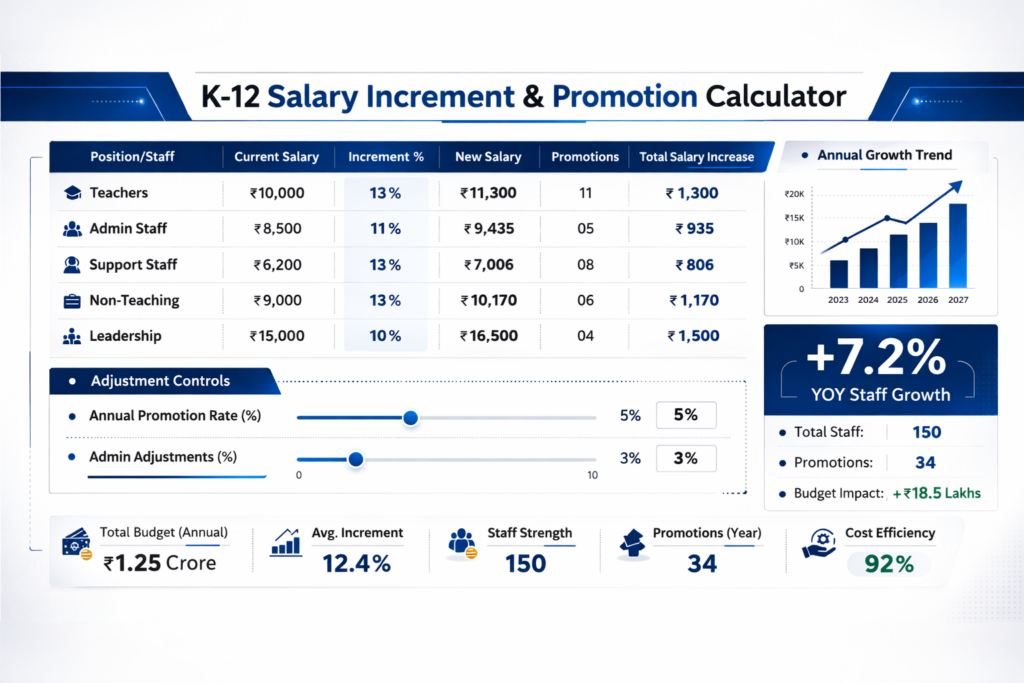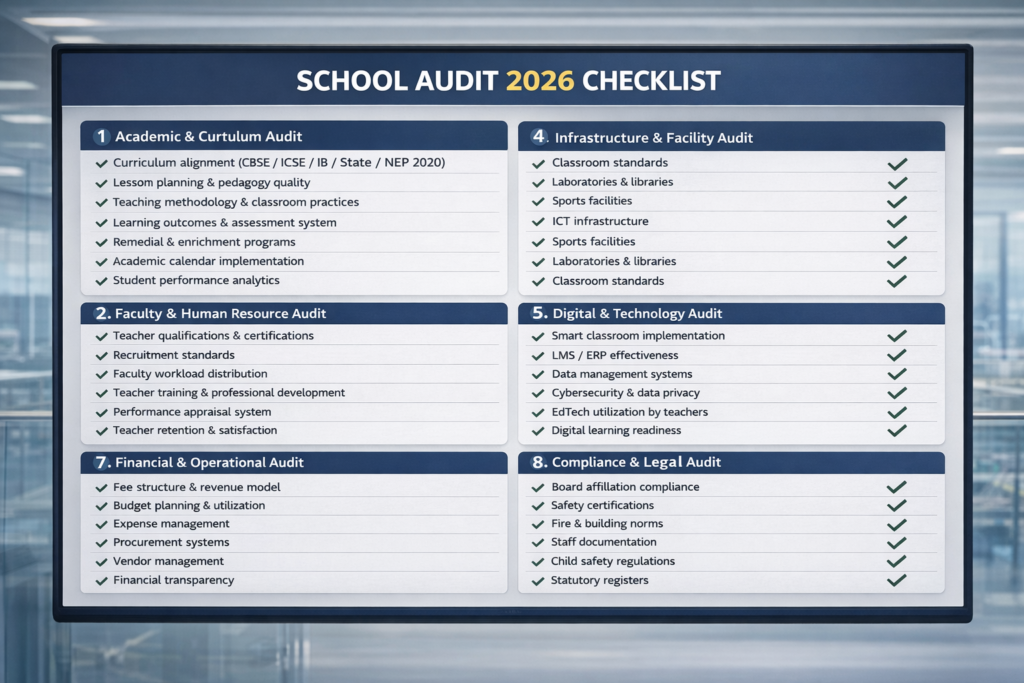


The Secret Blueprint for
Designing K-12 Ventures from Scratch
A 50-Point Institutional Architecture Blueprint for Multi-Board, Digital & AI-Enabled School Systems

The 4 Integration Departments
These core modules form the structural backbone when Designing K-12 Ventures from Scratch, ensuring
every administrative and pedagogical gear turns in perfect synchronicity.
STRATEGIC – Departments
- Governance
- Compliance
- Finance & Accounts
- Human Resources
- Digital Integration Campus
- AI School Transformation
- Teacher & Leadership Training
- Professional Development
DELIVERY – Departments
- Academics
- Academic Operations
- Central Examination
- Student Support Services
- SEN
- Counselling & Career Guidance
- Wellness & Holistic Development
- Labs & Experiential Learning
- Research & Innovation
- Entrepreneurship
- Hostel Management
- Campus Operations
INFRASTRUCTURE – Departments
- Campus Design
- Facilities Management
- Transport & Maintenance Management
- Canteen Management
- Procurement & Sustainability
- IT Infrastructure
- Safety & Security
- Smart Campus & Automation Systems
- Asset Lifecycle Management
- Environmental Health & Hygiene (EHS)
- Utility & Power Management
- Infrastructure Compliance & Audit
GROWTH & REVENUE – Departments
- Admissions
- Marketing
- Business Development
- Partnerships & Alliances
- Stakeholder Management
- International Programs
- Alumni Network
- Community Relations
The 50-Point Architecture Index
Vision, Market Mapping & Budget Archetypes
Defining the institutional “Why” and selecting market segments (Mid to Ultra-Premium).
Board Compliance & Unit Economics
Regulatory architecture (CBSE/IB/Cambridge) and the 10-Year Financial Blueprint.
Campus Design & Academic Systems
Spatial pedagogy, NEP 2020 alignment, and integrated curriculum layering.
HR Architecture & Governance SOPs
Faculty capability matrix, manpower planning, and centralized board control systems.
Digital, AI & Brand Engine
Tech stack integration, Admissions Engine, and Final Master Model delivery.
Market & Segment Strategy
Engineering high-yield educational assets requires precision from day zero.
I specialize in Designing K-12 Ventures from Scratch, transforming raw land into institutional legacies.

03. Catchment Feasibility Mapping — Location Intelligence Model
| Data Layer | Analytical Objective | Key Metrics Evaluated | Strategic Insight Generated | Decision Impact |
|---|---|---|---|---|
| Step 1 — Household Income Bands | Validate fee affordability ceiling | Median income, dual-income households, professional density | Defines viable fee bracket | Prevents overpricing or under-positioning |
| Step 2 — Competing Fee Structures | Market price benchmarking | Existing school fees, scholarship strategy, hidden costs | Identifies pricing gap opportunity | Enables differentiated positioning |
| Step 3 — Transport Radius Economics | Enrollment accessibility modeling | 3–7 km travel time, traffic density, transport cost ratio | Determines realistic catchment size | Drives enrollment velocity |
| Step 4 — Parent Aspiration Index | Demand psychology assessment | Career orientation, English preference, global exposure demand | Reveals board & pedagogy suitability | Avoids curriculum mismatch |
| Step 5 — Population Growth Trends | Future enrollment forecasting | Housing development pipeline, migration patterns, birth rate trends | Predicts long-term demand stability | Ensures sustainability beyond launch phase |
Strategic Mandate
No land acquisition or infrastructure CAPEX before data validation confirms enrollment viability and fee sustainability.
Catchment Decision Scorecard
| Parameter | Low Score Risk | Optimal Signal | Strategic Decision |
|---|---|---|---|
| Income Density | Price resistance | Stable fee absorption | Proceed |
| Competition Saturation | Overcrowded market | Differentiation gap | Launch Advantage |
| Transport Accessibility | Limited radius | Multi-zone access | Enrollment scalability |
| Aspiration Alignment | Curriculum mismatch | Clear demand identity | Board finalization |
| Population Growth | Stagnation | Expansion corridor | Long-term investment |
04. Segment Decision Framework — Institutional Positioning Architecture
| Segment | Target Demographic | Strategic Philosophy | Infrastructure Intensity | Fee Strategy | EBITDA Behavior | Expansion Model |
|---|---|---|---|---|---|---|
| Mid Budget | Aspirational middle class | Volume + Cost Efficiency | Functional & optimized | Competitive pricing | Stable margins | High replication |
| Affordable Premium | Upward mobility families | Value Positioning | Strong academics + selective facilities | Value-for-money premium | Strong scalability | Cluster expansion |
| Premium | Professional urban families | Outcomes + Infrastructure | Advanced facilities | Brand-led pricing | High yield | City flagship campuses |
| Ultra Premium | Elite & expatriate market | Exclusivity + Global Exposure | World-class campus | Prestige pricing | Long gestation, high upside | Limited flagship strategy |
Strategic Principle
Segment selection defines 80% of operational outcomes:
Wrong segmentation creates permanent financial inefficiency.
Segment Engineering Logic
| Variable | Controlled by Segment | Impact |
|---|---|---|
| Teacher salary band | Operating cost base | Campus size & design |
| Activity ecosystem | Brand perception | Technology investment |
| Parent communication style | Retention behavior | Admission funnel |
| Conversion rate | Capex intensity | Differentiation |
05. Competitive Dominance Rule — Market Entry Governance
| Evaluation Dimension | Strategic Question | Success Threshold | Decision Rule |
|---|---|---|---|
| Brand Gap Analysis | Can we be meaningfully different? | Clear positioning gap | Enter |
| Enrollment Capture Potential | Can Top-3 share be achieved? | ≥20–25% catchment share | Enter |
| Pricing Power | Ability to command premium? | Sustainable fee leverage | Enter |
| Academic Differentiation | Outcome superiority possible? | Measurable advantage | Enter |
| Expansion Optionality | Multi-campus feasibility? | Replicable ecosystem | Enter |
Dominance Mandate
Market entry is approved only when Top-3 institutional dominance is achievable within 36 months.
Competitive Entry Risk Filter
| Scenario | Strategic Action |
|---|---|
| Saturated premium market | Avoid entry |
| Strong legacy school dominance | Acquire or partner |
| Emerging residential corridor | First-mover advantage |
| Government infra development zone | Early positioning |
| Fragmented low-quality competition | Rapid scale opportunity |
Executive Strategy Statement
Institutional success is not determined by infrastructure or curriculum alone but by precision alignment between catchment economics, segment positioning, and competitive dominance probability.
Board & Compliance Architecture
Navigating the regulatory landscape is the most critical phase when Designing K-12 Ventures from Scratch.
While Designing K-12 Ventures from Scratch I ensure your institution is built on a foundation of total legal air-tightness and academic authorization.

08. State Board Compliance
- RTE Alignment: 25% quota and structural norms.
- Land Documentation: Ownership and diversion clarity.
- Recognition Files: Departmental NOC and fire/safety.
- Teacher Norms: TET/B.Ed eligibility discipline.
09. CBSE Affiliation Roadmap
- Land Norms: Campus size vs. enrollment ceiling.
- Mandatory Committees: POCSO, POSH, and SMC.
- Training Compliance: Mandatory 50-hour capacity building.
- Academic Calendar: Alignment with board exam cycles.
10. ICSE Governance Framework
- Subject Depth: Structuring Choice 1, 2, and 3.
- Documentation: Lab and library standards.
- Internal Assessment: Portfolio and project discipline.
11. Cambridge & IB Authorization
- Policy Framework: Academic Honesty & Inclusion.
- Certification: Professional development pathways.
- Moderation: Internal vs. External benchmarking.
Capital & Financial Blueprint
Precision in capital allocation is the difference between a school and a legacy when Designing K-12 Ventures from Scratch.
I architect financial models that ensure maximum EBITDA efficiency while maintaining elite academic standards.
13. Investment Planning Model
Strategic allocation of capital to ensure long-term solvency.
When Designing K-12 Ventures from Scratch, I Optimizing early-stage cash flow for sustainable campus development.
14. Break-Even Architecture
Engineering the path to financial autonomy and operational surplus.
When I Designing K-12 Ventures from Scratch always Balancing high-performance education with rigorous fiscal discipline.
15. Pricing Strategy
Market-aligned fee structures designed for parent value and institution growth.
Mapping the competitive landscape to define unique value-price positions.
16. Budgeting System
Rigorous expense management through predictive forecasting and real-time tracking.
Maintaining a lean operational profile while funding innovation cycles.
17. Revenue Diversification
Beyond the tuition fee: leveraging campus assets for alternative income streams.
Building financial resilience through multi-layered value offerings.
Campus & Infrastructure Engineering
Architecture in education is silent pedagogy. When Designing K-12 Ventures from Scratch,
every corridor and courtyard must be engineered to inspire learning while ensuring operational efficiency
and absolute student safety across every square foot.

19. Location & Site Strategy
Selecting the optimal soil for institutional growth and long-term brand equity.
Analyzing catchment demographics and accessibility for maximum intake potential.
20. Campus Zoning Model
Separating functions to ensure operational discipline and student focus.
A strategic Designing K-12 Ventures from Scratch flow that minimizes friction between academic and administrative life.
21. Infra by Segment
Aligning physical assets with your institutional market positioning.
From functional efficiency to world-class innovation hubs.
22. Safety Engineering
Total child protection through environmental design and tech-enabled monitoring.
Zero-compromise protocols for institutional peace of mind.
23. Transport & Movement
Mastering logistics is critical when Designing K-12 Ventures from Scratch. We engineer peak-hour drop/pick logic and medical access routes that ensure zero-bottleneck movement within the campus.
24. Future Expansion
Provisioning for tomorrow’s growth within today’s architectural footprint.
25. Parent Experience
Designing K-12 Ventures from Scratch the“Trust Pathway is majordly important “ : High-end reception architecture meets curated admission tour routes and impact-driven transparency boards to convert interest into enrollment.
Academic & NEP Systems
Designing K-12 Ventures from Scratch requires a shift from content-heavy teaching to competency-based mastery.
I architect academic frameworks that ensure your institution leads in both board results and holistic student growth.

26. Curriculum Mapping by Board
Standardizing academic delivery across diverse global and national boards.
In Designing K-12 Ventures from Scratch the critical part is Mapping content to ensure vertical and horizontal alignment across grades.
27. NEP 2020 Alignment
28. Academic Calendar Engineering
Integrating administrative deadlines with peak learning cycles.
Building a roadmap that balances rigorous assessments with co-curricular milestones.
29. Assessment Blueprint
Designing K-12 Ventures from Scratch build a Weighted design for future-ready evaluation:
30. Quality Assurance
Maintaining excellence through systematic institutional audits.
Validating classroom delivery against the planned curriculum standards.
31. Remediation Model
Bridging the gap for diverse learners within the classroom ecosystem.
Data-driven support structures to ensure no child is left behind.
32. Academic Dashboard
Real-time visualization of institutional learning health.
Translating raw data into actionable insights for the school leadership.
HR & Talent Architecture
When Designing K-12 Ventures from Scratch, your human capital is your only sustainable moat.
I help you build high-performance teams through institutionalized recruitment, staffing, and growth systems.

33. Recruitment System Design
Standardizing the entry gate for institutional quality to eliminate hiring bias.
Implementing rigorous filters that ensure only top-tier pedagogical talent joins your vision.
Rubric-based pedagogical evaluation.
Subject depth vs. Board requirements.
Alignment with institutional values.
34. Staffing Ratio Planning
Balancing academic excellence with operational sustainability.
Designing K-12 Ventures from Scratch the Scientifically calculating workforce needs to prevent burnout and maximize EBITDA.
35. Performance Appraisal Model
Moving from subjective feedback to data-driven increments.
Linking teacher compensation directly to measurable classroom outcomes.
36. Continuous CPD
Fostering a culture of lifelong learning for every faculty member.
Ensuring your staff stays ahead of evolving board norms and global pedagogies.
37. Career Ladder
Defining clear vertical growth pathways to ensure high staff retention.
Providing a transparent roadmap from entry-level teaching to academic leadership.
38. Leadership Development
Leadership in K-12 is not merely an administrative function; it is the engine of instructional quality. In Designing K-12 Ventures from Scratch We transition your Principals and HODs from being paper-pushers to being Instructional Leaders who drive classroom innovation.
Operations & Governance
When Designing K-12 Ventures from Scratch, operational excellence ensures that your vision survives the first day of school.
I build the invisible systems that maintain safety, nutrition, and administrative precision across your campus.

39. SOP Architecture
Standard Operating Procedures that eliminate person-dependency.
Designing K-12 Ventures from Scratch Codifying every critical workflow for total institutional accountability.
Academic SOP
Lesson planning, correction, and assessment delivery.
Admin SOP
Inventory, procurement, and facility management.
Discipline SOP
Student behavior, staff conduct, and grievance handling.
40. Front Office & Parent Systems
Standardizing the first point of contact to ensure professional parent engagement.
41. Canteen & Dining Governance
Ensuring world-class nutritional standards and food safety protocols.
42. Asset & Maintenance
Designing K-12 Ventures from Scratch requires a proactive approach to infrastructure longevity.
We implement military-grade maintenance schedules to protect your capital investment.
43. Governance Structure
Designing K-12 Ventures from Scratch requires a clear chain of command to prevent administrative friction.
Communication & Command Center
Designing K-12 Ventures from Scratch that build Standardized protocols for radical transparency and escalation.
Reporting & Escalation
Teachers, Class Teachers & HoDs have direct access to Vice Principal for urgent pivots.
Authorized direct mailing to: VP, Principal, Academic Head, and Campus Director.
Independent Committee forwards case closure reports directly to Group Director & CEO.
Meeting Cadence
HoDs meet Dept Teachers; Weekly reports submitted to Vice Principal.
Board meets CEO | Group Director meets all Campus Directors | Campus Director meets Principal & VP.
Campus Director meets separately with: 1. Teachers/HoDs, 2. Coordinators/Senior Coordinators.
Digital & AI Integration
44. ERP / LMS / CRM Blueprint
Establishing a single source of truth for institutional data.
Unified Data Model
Syncing finance, HR, and academics into one dashboard.
Admissions CRM
Automating lead follow-ups and conversion tracking.
Parent App
Real-time transparency for fee, attendance, and progress.
45. AI in Academics
- Adaptive Testing: Difficulty levels that adjust to student ability.
- Predictive Remediation: Identifying learning gaps before exams.
- Learning Analytics: Teacher impact vs. student outcome mapping.
46. AI in Ops & Finance
- Enrollment Forecasting: Using historical data to predict seats.
- Collection Trends: Identifying payment risks early.
- Payroll Analytics: Optimizing staff costs vs. growth.
Admissions & Brand Engine
48. Brand Positioning by Segment
The emotional hook that aligns with the price point:
49. Conversion System
Moving from “Walk-ins” to “Enrollments” via system discipline.
- Counselling Scripts: Benefit-led vs. Feature-led communication.
- The 10-Minute Rule: Instant response to digital inquiries.
- Retention Mapping: Protecting the base while acquiring new leads.
50. The Final Institutional
Architecture Model
Designing K-12 Ventures from Scratch ultimately comes down to five integrated layers. If any layer is weak, the entire system destabilizes.
When all five layers align, the institution becomes:
Designing K-12 Ventures from Scratch is not construction. It is system engineering.
And system engineering is what separates ordinary schools from institutional brands.
Strategic Q&A
Clarifying the architecture of institutional success.